
World lore and factions
The store page sets up a prophecy about the Traveller and the truth about the Eye. Lore arrives through books, conversation and exploration, and covers the history of magic and the ancient races.
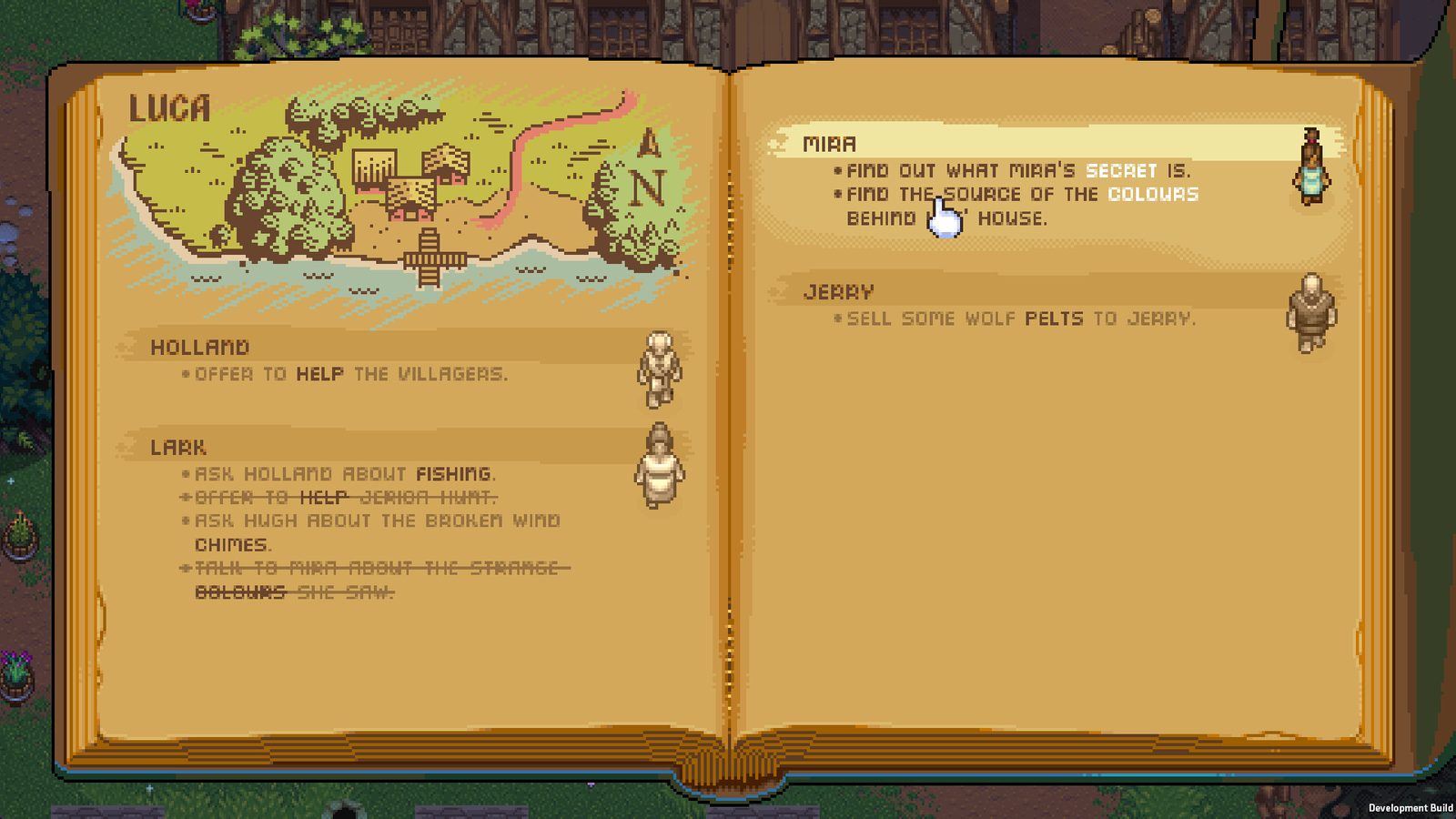 Official Steam screenshot
World of Anterra sells itself on its world before it sells anything else. The store page's short description opens with a prophecy, names you the Traveller, and asks whether you are here "to save Anterra or yourself". The official site calls the project "an innovative, open world roleplaying game" influenced by classic and modern games, and puts deep lore in the same sentence as fast combat.
That framing matters because it tells you what kind of RPG this is. The lore is not a codex bolted onto a map; it is delivered through the systems: conversation, books, ruins, and a world where people have jobs and gods have histories.
The frame the store page gives you
| Element | What the official material says |
|---|---|
| The prophecy | It foretold your coming, Traveller |
| The question | Whether you are here to save Anterra or yourself |
| The Eye | The truth about the Eye is the goal; uncovering it makes you Anterra's Champion |
| The world | Expansive and living, with thriving towns, wild animals and monster-filled dungeons |
| Magic | A history of magic exists and can be learned |
| Ancient races | Named as a subject you learn about in play |
| Factions | Dangerous factions are named among the world's hazards |
| Instability | Unstable magics and tortured creatures beset the world |
| Places named | Mancian Wastelands, crypts, caves, houses, bogs, oceans, mountains |
Only one proper place name appears in the public material: the Mancian Wastelands, named in the March 2026 explosion post as the place where Boom Barrels are generally used for mining. Everything else is described by category rather than by name.
How lore reaches you
The store page is explicit that lore is a discovery system. You uncover the mysteries of Anterra by asking questions, interacting with the environment, reading books and exploring; that is how you learn about the history of magic and the ancient races.
Four consequences follow, and they are practical:
- Books are loot. If reading books teaches history, then a library is a treasure room and a bookshelf is worth a detour.
- Ruins are documents. Sneaking into crypts, caves and houses is described as the way to find secrets, which makes architecture a source of information.
- Conversation is a research tool. With typed questions, "what happened here" is a mechanic rather than flavour.
- The world is inconsistent on purpose. Unstable magic and tortured creatures mean the setting is not a stable backdrop; things are wrong, and finding out why is the plot.
The dialogue and quests guide covers the conversation half of that method.
Factions, hazards and the shape of the map
The store page names dangerous factions alongside unstable magics and tortured creatures as the things that make Anterra dangerous and unpredictable. It does not name the factions, their goals or their territories.
What it does say about geography is broad but useful: oceans, continents, mountains, caves and dungeons, with thriving towns in between. That is a world built at the scale of travel rather than at the scale of a single valley, and the water post's talk of sailing fits a map with real coastlines.
The practical reading is that faction territory is likely to be regional rather than urban: a wasteland with mining operations, a coast with sailing, mountains with caves. If you want to prepare for that, the water guide covers the coastal layer and the crafting guide covers what a mining region implies.
The Traveller, the Eye and the Champion
Three terms carry the main plot, and all three come from the store page.
The Traveller is you: the prophecy foretold your coming. The Eye is the mystery at the centre; uncovering the truth about it is described as the route to becoming Anterra's Champion. The framing question, whether you are here to save Anterra or yourself, suggests the game intends to keep your motive ambiguous rather than cast you as a straightforward hero.
That is a story hook rather than a synopsis, and the studio has not published more of the plot. Anything that names an antagonist or a twist for this game is not quoting 81monkeys.
Lore you can already read
Two of the twelve Steam announcements are effectively lore documents in disguise. The Founder's Journals describe the studio's own history: a mobile-first period, a funding partner lost to COVID, unpaid months, contract work on other projects, a Kickstarter that ended above 300% of its goal, and an explicit statement that the studio never sold or profited from NFTs.
That is not Anterra's fiction, but it explains the game's tone. A studio that spent years on the edge tends to write about unstable magic and failing institutions with some feeling, and the dev updates guide has the full timeline.
Why the setting reads as unstable
The store page's most evocative sentence is that Anterra is "beset by unstable magics, dangerous factions, and tortured creatures". That is a setting with a wound in it, and it explains why the world can be both beautiful and hostile.
For a player, instability is a promise about variety rather than difficulty. A world where magic is unstable can justify a dungeon that behaves strangely, a creature changed by something, or a ruin that is dangerous for reasons a book explains. The progression and loot guide treats those same ruins as loot maps.
Reading a world before you can walk it
Until launch, the useful preparation is to learn the vocabulary: Traveller, the Eye, Champion, ancient races, the history of magic, the Mancian Wastelands. Those are the terms the game will use, and the questions it invites you to type will be about them.
If you want one habit to carry into launch, make it this: read what the world gives you. In a game where books teach history and NPCs keep schedules, the player who reads has a map the player who rushes does not.
Next
- Dialogue and quests — how you ask the world about itself.
- Progression and loot — why knowledge counts as progression here.
- What is World of Anterra? — the systems view of the same world.
If you only remember three words from this page, make them the Eye, the Traveller and the Champion: they are the game's own coordinates for its plot.