
Crafting, camping and building
Camping, crafting, building, resource gathering and fishing are all named by the official site. Camps and taverns handle rest, and Boom Barrels are the volatile mining tool of the Mancian Wastelands that doubles as an exploration and combat aid.
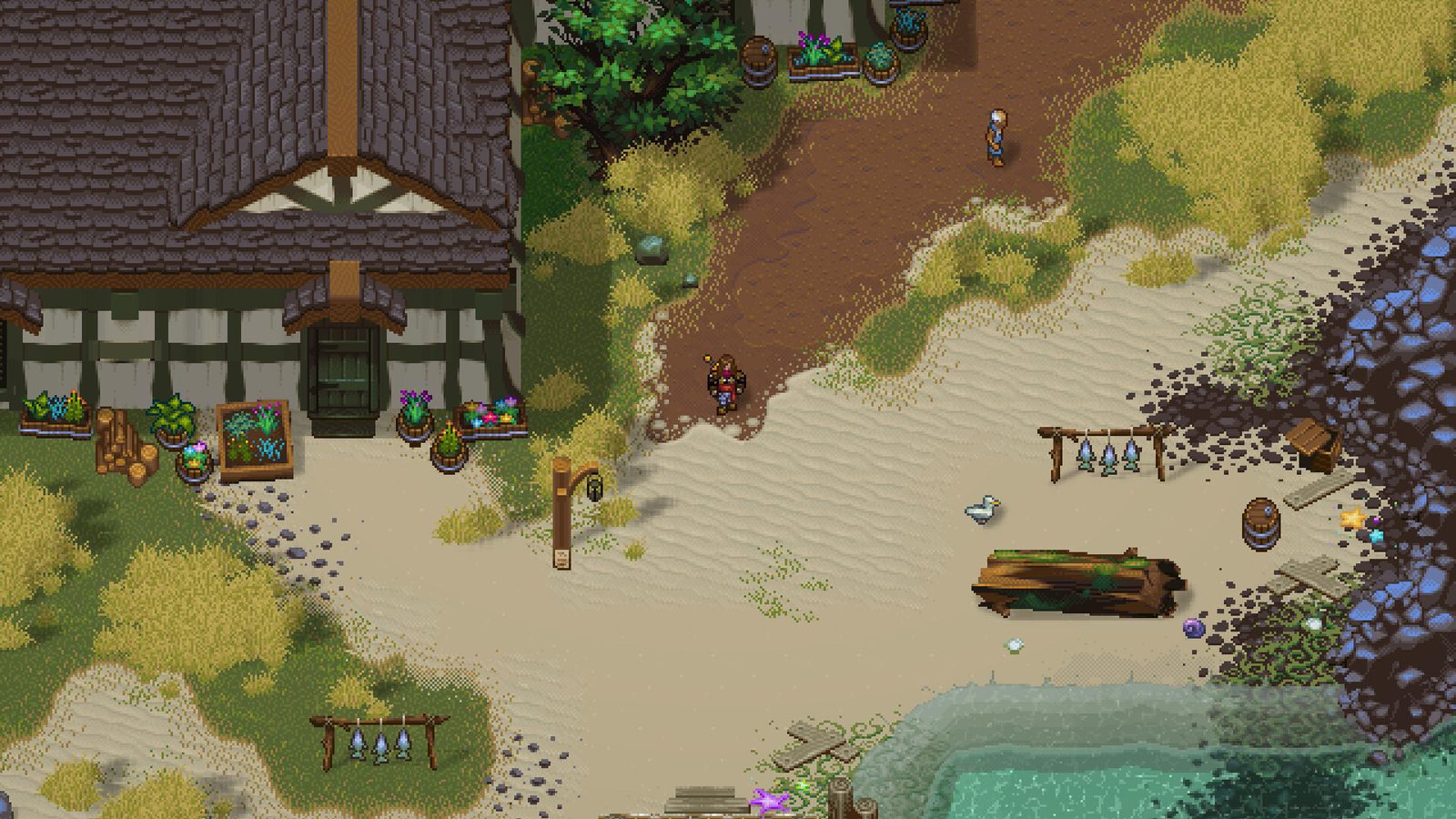 Official Steam screenshot
The activity layer of World of Anterra is stated in one line on the official site: "Camping, crafting, building, resource gathering, fishing, and more." The Steam store page fills in the surroundings: taverns to rest in, camps to sleep the darkness away, logs to sit on, and a world where NPCs have jobs, meals and hobbies of their own.
Together they describe a survival-adjacent loop inside an RPG rather than a survival game. Nothing in the material shows hunger meters; you gather outside, make and buy inside, rest at a camp or a tavern, then carry the result into a crypt.
The activities, one by one
| Activity | What the official material says | What it feeds |
|---|---|---|
| Camping | Set up camps to sleep the darkness away | Rest between expeditions, night cycle |
| Tavern rest | Rest in friendly taverns | Rest inside towns, social hub |
| Crafting | Crafting named in the official activity list; fuses can be crafted | Consumables, tools, combat preparation |
| Building | Building named in the official activity list | Camps and structures in the world |
| Resource gathering | Resource gathering named in the official activity list | Crafting inputs |
| Fishing | Fishing named on the official site and in the water post | Food and water-side activity |
| Sailing | Sailing named in the water post | Travel across water |
| Mining | Boom Barrels used mainly for mining in the Mancian Wastelands | Ore and excavation |
Everything above is a paraphrase of either the official site's Key Features block or the Steam announcements. No recipe list, material count or build limit is published.
Boom Barrels and the fuse loop
The most concrete crafting detail the studio has published is the explosion post from March 2026. It describes a powerful, volatile substance used generally for mining in the Mancian Wastelands, found in other places too, and useful "for things like exploration or combat" in the right hands.
The post adds the practical half: keep your distance, and keep spare fuses, which "can be found, purchased, or crafted". That single sentence describes a three-source economy for a consumable, which is the clearest window into how crafting sits next to looting and shopping.
It also tells you the intended pace. A tool that is found, bought or made is a tool the game expects you to use often, and an explosive that works on rock, on doors and on enemies is a general-purpose key.
Rest as a mechanic
Both rest verbs in the material are placed in the world rather than in a menu. Taverns are "friendly" places inside towns; camps are things you set up in the wild "to sleep the darkness away"; and the store page adds the smallest detail of all, sitting on a log to enjoy the sights and sounds of a living world.
That reads as a day-night rhythm: towns for safe rest, camps for the road. Since the store page also lists day-night cycles as a technical feature, the two systems are clearly meant to be experienced together. The world lore and factions guide covers how towns and factions fill that map.
Gathering inside a handcrafted world
Resource gathering in a hand-drawn world is a different promise from gathering in a procedurally generated one. If the map is handcrafted with oceans, continents, mountains, caves and dungeons, then a resource node is placed by a designer, and the interesting question is where, not how many.
The water post is the best example of that philosophy. It says there are resources, creatures and enemies that can only be found in or near water, which turns a river into a reason to walk along it. Fishing and sailing then sit on top of the same water.
The water, fishing and sailing guide works through that layer in detail.
Building, at the scale the game implies
The official site lists building in the same breath as camping, which suggests structures in the world rather than a separate construction game. A camp is the smallest unit of building; anything beyond that is not described.
If you come from survival games, adjust the expectation: nothing promises walls, defences or base raids. What it promises is a world where you can make a place to sleep, and a fire to sit at while the weather runs.
Shops, schedules and the reason to stay in town
NPCs in Anterra go to work, socialise, eat meals and pursue hobbies, according to the official site, and the store page adds that taverns are for resting. Together those lines make a town a schedule rather than a menu: the shopkeeper is somewhere, the tavern keeper is somewhere, and the person you need may be off duty.
That is why the activity list belongs next to the dialogue system. Gathering takes you out of town; crafting and buying bring you back; and the town's own rhythm decides who is available when you return. The dialogue and quests guide covers the conversation side.
Night, weather and why camping exists
The store page lists dynamic weather and day-night cycles as technical features, and separately describes setting up camps to sleep the darkness away. Those two statements belong together: night is a condition you plan around, and a camp is the answer to it.
The water post adds the weather half from the other direction, describing rain ripples on ponds and cloud reflections on lakes. If weather changes the look of the world that thoroughly, it plausibly changes the feel of travelling through it as well.
Preparing for the loop before launch
The loop is easy to prepare for because it is mostly about habits:
- Decide how you feel about consumables. If combat leans on rare items, hoarding everything is a losing strategy.
- Plan to walk the water. Resources and enemies are stated to exist only in or near water, so coastlines are content.
- Expect to shop and to loot the same items. Fuses are explicitly findable, buyable and craftable.
The combat system guide explains why a stocked bag is a build decision, and the progression and loot guide covers where the materials come from.
Next
- Water, fishing and sailing — the environment that supplies half the map's materials.
- Combat system — why crafted items decide hard fights.
- Progression and loot — where gear and materials are hidden.