
Dialogue and quest design
Dialogue is retro-inspired and conversational, and you can type your own questions. Quests follow non-linear, divergent paths, so where you go and who you talk to shapes the story you get.
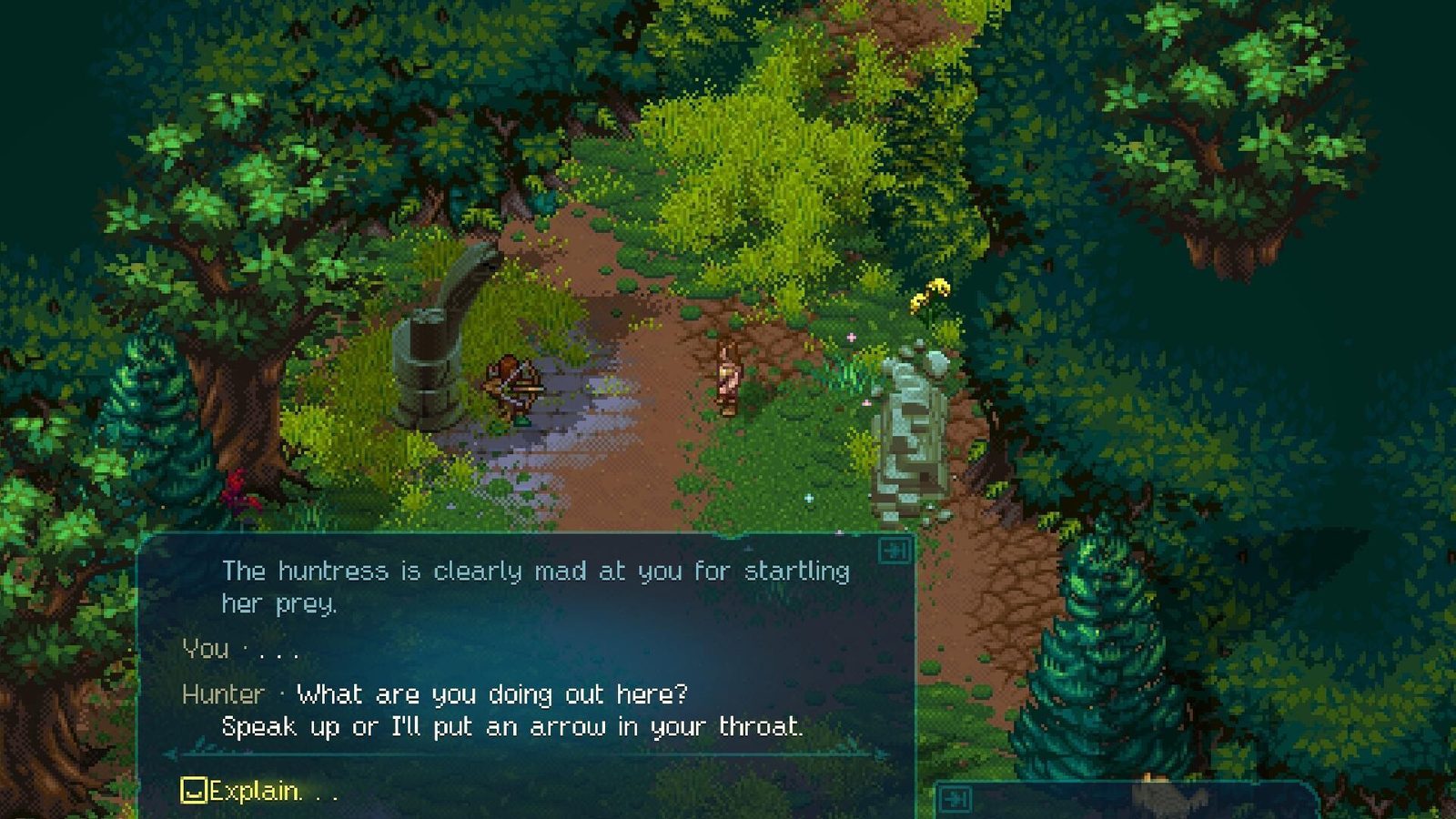 Official Steam screenshot
World of Anterra's dialogue system is the most unusual thing on its store page. The official site calls it "a unique dialogue system that allows players to have a more conversational experience with every character in the game", and then adds the line that makes it memorable: "You can even type your own questions!"
That is a rare promise to put in a store description, because a game that lets you type questions has to answer them. The store page explains how: conversation, environment, books and exploration.
The three ways the world talks
| Channel | What the official material says |
|---|---|
| Dialogue | Retro-inspired, conversational, with typed questions of your own |
| Environment | Interact with the world to uncover its mysteries |
| Books | Reading books teaches the history of magic and the ancient races |
| NPC schedules | NPCs work, socialise, eat and pursue hobbies, so who is where changes |
| Quests | Non-linear and divergent; your path shapes the story you get |
Notice that only the first row is a menu. The other four are world systems, and the store page presents them as a single method: ask questions, interact, read, explore.
What "non-linear" means here
The official site says the story and quests "follow non-linear, divergent paths, so you can go where you want and talk to whomever you'd like", and that your story unfolds naturally based on the paths you choose.
That is a structural promise rather than a content promise. It says the game will not gate you behind a single quest chain, and it says the branches diverge, which implies that some content is mutually exclusive. For a player, the practical consequence is that a first playthrough is a reading of one path rather than a tour of everything.
Typed questions in practice
A typed-question dialogue system has three design problems: understanding the input, answering within the fiction, and keeping the answer true. The studio has not published how it solves any of them, so what follows is what the store page commits to rather than how it works under the hood.
What is committed is that every character is conversational, a broader claim than "ask the quest giver about the quest": it suggests the same interface works on ordinary villagers.
If that is true, the information economy changes. Instead of reading a quest log, you ask a person. Instead of a codex entry, you ask about the history of magic. That is the loop the world lore and factions guide treats as a system.
Quests and the living world
The store page puts non-linear quests next to a living world in which NPCs keep schedules. Those two statements reinforce each other: if an NPC moves through a day, then when you talk to them matters, and a quest can be missed or caught depending on timing.
It also explains why the game can afford to be non-linear. A world where people have routines generates its own leads; you do not need a quest marker if the blacksmith is visibly at work and the tavern keeper is visibly serving.
Reading a conversation-driven RPG
Four habits follow from the published design, and they are worth adopting from the first hour:
- Talk to everyone. The system's promise is that every character is conversational, not just the ones with quests.
- Ask specific questions. A typed interface rewards specificity; "where is the crypt" is a better question than "help".
- Read what you find. Books are named as a lore channel, and lore is how you learn which ruins matter.
- Notice the time. Schedules mean the same person is a different source at different hours.
The crafting and camping guide covers the rest mechanic that lets you pass time deliberately.
Dialogue next to combat
The store page presents dialogue and combat as the two halves of the same loop: the interface is built around "tactile items and icons rather than menus and text", and dialogue is the exception that proves the rule. One screen is items, the other is language.
That split is deliberate. It keeps the menus thin, which is why the combat system guide can describe a fight that is easy to start and hard to master: there is no wall of text between you and the grid.
What to ask first
A typed dialogue system rewards having questions ready. These are the ones that follow the published design, and all of them are about the world rather than about quest markers:
- Who lives here, and what do they do during the day?
- What happened to the people who built this ruin?
- What is the Eye, and why does the prophecy mention a Traveller?
- Which roads are dangerous right now, and why?
The last question is the one that turns dialogue into routing. If factions and unstable magic make parts of the map risky, a local is the cheapest source of that information, and the world lore and factions guide explains what those factions are.
What is not published
There is no dialogue tree, no quest list, no faction reputation system and no transcript of a typed exchange in the public material. The store page describes the capability, and the announcements describe art and tools.
This page therefore sticks to the design as stated. When the studio publishes a dialogue feature post, this is the page that will grow examples.
Dialogue and the store page's own summary
The store page groups dialogue with the world rather than with the plot: you uncover mysteries by asking questions, interacting, reading and exploring. That ordering is a hint about emphasis. Conversation is not there to deliver cutscenes; it is there to answer questions about a place.
If you plan to play at launch, treat the first town as a library and its people as indexes. Everything else in this guide follows from that posture.
The short version
Conversation is the game's information system: typed questions, scheduled people, books that carry history, and quests that diverge because you chose a direction. If you remember one thing from this page, make it this: the question you ask is the content you get, so arrive with questions rather than with a route.
Next
- World lore and factions — what the books and the answers are about.
- Crafting, camping and building — rest, time and the day-night rhythm.
- Combat system — the other half of the interface, built on icons.